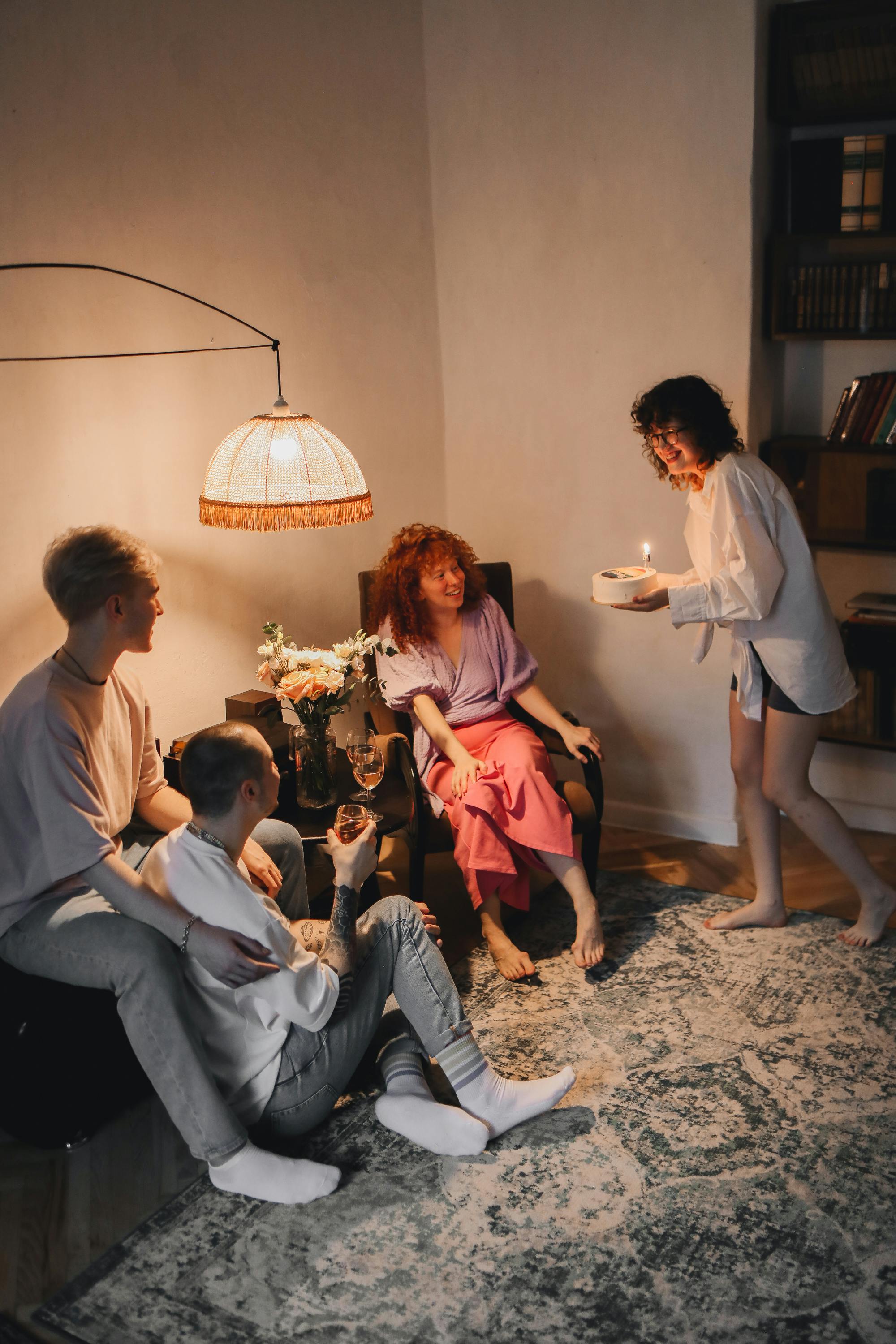
How to Arrange Furniture for a Birthday Party: A Practical Checklist
Birthday-party furniture planning is not decor therapy. It is crowd control with cushions, cake, and fewer excuses.
If the room feels jammed before anyone arrives, the problem is usually not the guest list. It is the layout. People need a clear route from the door to the seating, from the seating to the food, and from the food back out without doing awkward chair ballet. Maximum seating is a lie if nobody can walk.
This guide is for the day before and the day of. Use it to rule out the usual failures first: blocked door swings, a cake table sitting in the traffic lane, too many chairs, dim serving light, and cables stretched where actual feet will go. If you want the broader site context first, start from the home page or the short about page. Then come back here and move furniture with a plan instead of optimism.
Quick Room-by-Room Flow Map
| Area | Main Job | What Must Stay Clear | First Failure to Rule Out |
|---|---|---|---|
| Entry | Arrival and coat drop | Door swing and first walkway | Guests stopping in the doorway |
| Living room | Seating and conversation | Main path to cake and drinks | Too many chairs packed into one cluster |
| Dining area or side wall | Sweets, cake, gifts, and refills | Access around the table edges | One giant serving bottleneck |
| Kids’ corner, if needed | Play and decompression | Distance from breakables and cables | Setting it beside the serving lane |
Start With the Basics: Guest Count, Party Style, and Room Dimensions
Check the boring thing first. Before you move one chair, define the load on the room. A birthday dinner for ten behaves differently than a mixed-age cake-and-games party for sixteen, even if both happen in the same space.
- Write down the expected guest count and the realistic maximum, not the fantasy number.
- Mark the party style: seated meal, mixed standing and sitting, games, cake-and-sweets focus, or mostly casual hanging around.
- Measure the main room length and width. If you are using lamps, photo corners, or string lights, check ceiling height and outlet access too.
- List fixed constraints: doors, windows, vents, radiators, fireplace, built-ins, stairs, and any furniture you are not moving.
- Decide which rooms are active and which rooms stay quiet or closed.
Common mistake to avoid: counting every possible chair as usable seating. It looks generous on paper and turns into traffic sludge in real life.
Action check: if you cannot walk the likely guest route comfortably with the current furniture count, remove one piece now before you plan anything else.
Make a Simple Floor Plan: Mark Doors, Windows, and Fixed Furniture
You do not need software. A quick sketch on paper or a phone note is enough. The point is to stop guessing. Guessing is how the dessert table ends up exactly where the bathroom door needs to open.
- Draw the room outline and mark every doorway with the direction of the door swing.
- Add windows, radiators, vents, fireplace edges, built-ins, and anything fragile or immovable.
- Mark the furniture you are keeping in place first, then sketch the pieces you may move.
- Shade the no-go areas: narrow passages, hot surfaces, fireplace fronts, and corners where guests should not cluster.
- Mark where guests will enter, where coats or bags will land, and where the serving area could expand if the party gets denser than expected.
A floor plan exposes bad assumptions quickly. It also gives you a place to test options before you drag a sofa six inches at a time and call it strategy.
Common mistake to avoid: sketching furniture but forgetting door arcs and windows. Door collisions are not a surprise. They are a skipped step.
Action check: finish the sketch and circle the three pressure points that will jam first: entry, serving edge, and the path to the bathroom or kitchen.
Create Clear Walking Paths: Where People Should Move and Where They Shouldn’t
Here is the actual problem most hosts are trying to solve: flow. Guests do not move like neat arrows. They stop, turn, chat, carry drinks badly, and forget that a chair leg exists. Your job is to give them routes that still work when people behave like people.
- Choose the primary path from the entrance to the main seating zone.
- Choose the second path from the seating zone to the cake or serving table.
- Keep those routes open enough for two-way movement, especially if plates and drinks are involved.
- Do not route guests behind the cake table or between the back of a chair cluster and a wall.
- If the room is tight, reduce seating density instead of forcing one more chair into the choke point.
Most awkward birthday setups come from trying to make one surface do three jobs at once. When the path to the sweets station also works as the photo area, the gift drop, and the route to the kitchen, the room starts arguing with itself.
Common mistake to avoid: leaving a beautiful central table in place when it splits the room in half and everyone has to orbit it.
Action check: walk the path carrying a plate and a drink. If you need to sidestep, pivot, or apologize to imaginary people, the route is wrong.
Choose Zones: Seating, Food or Serving, Gifts, and Kids’ Corner if Needed
Zones make the room readable. Guests should understand where to sit, where to put a gift, where the sweets are, and where children can land without you narrating the house like a museum guide.
- Seating zone: use the living room or the calmest open area. Angle chairs and sofa seating toward each other, but leave one edge open to the main walkway.
- Serving zone: place it near the kitchen or refill route, but not in front of the kitchen entrance. A side wall or dining edge usually works better than a dead center placement.
- Gifts zone: give gifts a visible home that is out of the footpath. A bench, console, or spare chair against a wall is usually enough.
- Kids’ corner: if children need a play spot, keep it out of the serving lane and away from breakables, sharp corners, and power strips.
- Use boundaries so each zone reads clearly: a rug edge, a side table, a console, or a line of chairs can do the job.
Think room by room. The living room carries conversation. The dining wall or sideboard handles sweets and refills. The entry catches coats. A spare corner handles gifts. Once each part of the house has one obvious job, the host has fewer small crises to solve.
If you want the broader furniture logic for a general event, read How to Arrange Furniture For A House Party. If you want a lighter companion page that stays birthday themed, there is also The Way to Organize Furniture To Your Birthday Party. This checklist is the stricter version.
Common mistake to avoid: putting gifts in the same corner guests need to cross to reach cake, drinks, or the bathroom. Wrapped boxes become accidental barricades fast.
Action check: assign every active room or corner one job only, then say those jobs out loud. If a zone has two or three jobs, split it.
Decide the Centerpiece Layout: Where the Main Table or Sweets Station Should Go
The birthday centerpiece is where people stall. That can be fine if the area was built for gathering. It is a mess if the cake table sits inside the only clear route through the room.
- Place the cake or sweets station where guests can approach from one side, gather briefly, and then peel away without backing into seated people.
- Keep at least one clean edge for the host or helper to refill plates, cut cake, or reset the display.
- Keep the station away from door swings, hallway turns, and the exact spot people will use for arrivals.
- If there is more than one food surface, stagger them. One sweets station and one drinks station usually flow better than a single overloaded table.
- If you expect photos, leave a bit of breathing room near the cake table so guests are not pressed against the wall during the one moment everyone suddenly wants a picture.
The sweets table should support traffic, not collect it. In practice, that means choosing a side wall, dining edge, or alcove more often than a room center. The room does not care about symmetry. It cares about whether people can move.
Common mistake to avoid: treating the cake table like a shrine and centering it where every guest path already converges.
Action check: stand where the cake table will go and trace the guest loop with your eyes: arrive, queue, serve, step aside, sit. If you cannot see the exit path clearly, move the table.
Optimize Seating: Mix Chairs and Sofas, Leave Conversation Space, and Keep Backup Options Nearby
Birthday seating should be flexible, not exhaustive. You are not furnishing a waiting room. You are giving people enough places to land without freezing the room into one rigid arrangement.
- Mix one anchored seating piece, like a sofa, with lighter chairs that can pivot toward the conversation or slide aside later.
- Leave enough space for someone to stand up without trapping the next person in place.
- Keep at least one side surface within reach for drinks or plates in each seating cluster.
- Stage extra folding chairs nearby, but not in the room, so you can deploy them only if the guest count actually demands it.
- If the dining table might host games after cake, decide when it changes roles. Do not force one table to be dining, gifts, games, and cake all at once.
Living-room seating should feel open toward the main path, not sealed off into a tight ring. Dining seating should be partial unless you are serving a real sit-down meal. A side chair used as a backup seat is more useful than a full row of chairs nobody can get around.
Common mistake to avoid: pushing every seat against the wall and calling the empty middle “space.” Empty middle space is useless if every conversation is stranded along the perimeter.
Action check: remove one chair from the tightest cluster. If the room immediately feels easier, that chair was the problem, not the guest count.
Plan Lighting and Comfort: Task Lighting, Ambient Light, and Temperature
People notice bad comfort faster than they admit it. They just express it by crowding the warm corner, avoiding the dark side of the room, or standing in the kitchen because the living room feels weird. Comfort is part of layout because it changes where people settle.
- Give the cake or serving area direct enough light that people can actually see plates, candles, and what they are picking up.
- Use softer ambient light in the main seating zone so the room feels settled instead of clinical.
- Check drafts, vents, and heaters before you assign the longest-stay seats.
- Keep a simple fix ready: fan, blanket basket, extra layer, or one small lamp moved to the right place.
- If children are using a corner for games or coloring, make sure that corner is bright enough to be usable without dragging everyone toward the serving table.
A dim cake table creates awkward clustering because everyone leans in. A cold sofa corner becomes empty, then the other side of the room gets overloaded. These are layout problems wearing a comfort costume.
Common mistake to avoid: lighting the room for photos only. Guests still have to use the place after the photo is done.
Action check: turn on the exact lights you plan to use and stand in each zone for thirty seconds. If one area feels dim, glaring, drafty, or dead, fix it now.
Set Up Power and Charging Access for Music and Phones Without Trip Hazards
Music and charging fail in very predictable ways. Someone chooses the nearest outlet instead of the safest one. Then a cable crosses the best walkway in the room, and now the playlist is trying to injure your guests.
- Choose the speaker location before plugging anything in.
- Route cords along walls, behind furniture edges, or under surfaces where feet do not travel.
- Use one accessible power strip near a wall instead of several devices fighting over a visible outlet in the main path.
- Keep the charging spot close enough to reach, but not so central that guests cluster around it.
- If the birthday setup includes lights, a phone for music, or a camera charger, test all of it before the final furniture reset.
The rule is simple: if a cable needs tape because it crosses a walkway, the cable is in the wrong walkway. Move the furniture or move the device. Do not turn bad routing into arts and crafts.
Common mistake to avoid: placing the speaker on the cake table side because the outlet is nearby, then forcing guests to queue around both music gear and dessert.
Action check: trace every cable with your hand. If it crosses a footpath, reroute it until it does not.
Final Walkthrough: The 10-Minute Pre-Party Check
This is the last useful step before guests arrive. Ignore it and the room will reveal its flaws at the exact moment you stop having time to fix them.
- Walk the main entry path as if you are arriving with a coat, gift bag, plate, or drink.
- Open every door that matters and confirm nothing collides with a chair, gift stack, or side table.
- Check rugs, cords, and chair legs for trip hazards.
- Stand in the seating zone and confirm guests can still see where cake, gifts, and drinks live.
- Confirm the kids’ corner, if you set one up, is reachable without crossing the serving lane.
- Run the first 30 minutes in your head: arrival, coat drop, gift drop, drinks, seating, cake. Watch where people will bunch up first.
- Remove one more unnecessary item if anything still feels too tight. The room will not miss it.
Common mistake to avoid: declaring the layout finished before testing it with doors open and serving surfaces actually loaded.
Action check: do the walkthrough ten minutes before guests arrive, not two hours earlier. Setup drift is real.
Conclusion: The First Diagnostic Step Before You Move Anything Else
The fastest way to improve a birthday-party room is still the least glamorous one: identify the main path, then stop putting furniture in it. After that, the rest gets simpler. Zones become obvious. The cake table stops causing traffic. Gifts stop living on the floor. Seating starts working like seating instead of storage with cushions.
If you want a next step beyond this article, start by drawing the floor plan and removing one unnecessary piece from the busiest room. Then use the rest of the checklist in order: paths first, zones second, centerpiece third, seating density fourth. That order solves more problems than style ever will.
For broader site help, you can return to the home page, read the property overview on About, check practical details on Support, or use the Contact page if you need direct follow-up.
If event planning becomes part of a hospitality workflow, Flatlogic's custom web development services can help frame how booking forms, checklists, and follow-up tools might fit together.